What we do
Our Projects
NeuroGuard
The flagship project of the Scientific Club, NeuroGuard, aims to create an innovative user authorization and authentication system using EEG waves. Secondary project goals include analyzing how neural similarity and synchronization affect the authorization process, and testing the impact of brain activity variability – such as changes over time or due to emotional state – on the system's effectiveness.
Learn more→
MindStride
The MindStride project focuses on exploring applications of Brain-Computer Interface (BCI) and Motor Imagery (MI) technologies. Our main goal is to develop the aspect of imagining movement. This will enable the practical application of our solution both in terms of entertainment and potentially improve the living conditions of people with disabilities.
Learn more→
Bore No More
Bore No More is an open, extensible framework that allows you to harness the power of BCI in applications built inside Unity. The team is currently working on classifiers for boredom, flow, and nervousness. The project can be used to adjust the difficulty level of games or during study sessions. Bore No More was awarded second place at the NTX Hackathon.
Learn more→
Neurocall
Neurocall is a research project for which we received a FAST grant from the Wrocław City Hall. Its aim was to investigate the possibility of controlling a mobile application using BCI. To do this, they tested the brain's response to 4 colors - green, yellow, blue and red. The created classifier was used to build an application that allows you to call one of the selected contacts based on the color the user is thinking about. The project was created for the elderly and people with disabilities.
Learn more→
NeuroSniper
NeuroSniper is a research and technology project focused on exploring the use of Brain–Computer Interfaces (BCI) in 3D computer games. The main objective of the project was to create a game in which the player’s brain activity directly affects gameplay mechanics. The system uses EEG signal analysis to determine the user’s levels of concentration and relaxation, translating these parameters into weapon behavior in the game.
Learn more→
Neurobeat
generates music based on brain waves. By analysing Alpha, Beta, Gamma and Teta wave readings, we want to provide a completely new experience based on EEG technology. With the help of an emotion recognition model, which will make you listen to different music depending on how you feel!
Learn more→
NeuroSpeller
NeuroSpeller is a research project aimed at enabling text input using EEG signals and visual attention. The system is based on the SSVEP (Steady-State Visually Evoked Potentials) phenomenon, in which brain activity synchronizes with the frequency of an observed visual stimulus. EEG signal analysis allows for determining which interface element the user is focusing on, enabling control of the system using vision alone.
Learn more→
BrainBoard
The Virtual Keyboard will enable users to communicate and interact by typing completely hands-free. Utilizing a brain–computer interface (BCI) in the project will allow the keyboard to be controlled based on the collected brain signals.
Learn more→
EEG2Text
The primary objective of the EEG2Text project is to create an innovative model capable of mapping non-invasive EEG signals directly into text. The team aims to develop a system that will allow for the reconstruction of thought content, based on the assumption that the processes of listening, reading, and thinking generate similar, decodable neural patterns.
Learn more→
PosyVibe
The project's goal is to create a system that generates music tailored to our mood. Thanks to its capabilities, it can become an ideal aid in therapy - becoming our daily helper that improves our emotional state.
Learn more→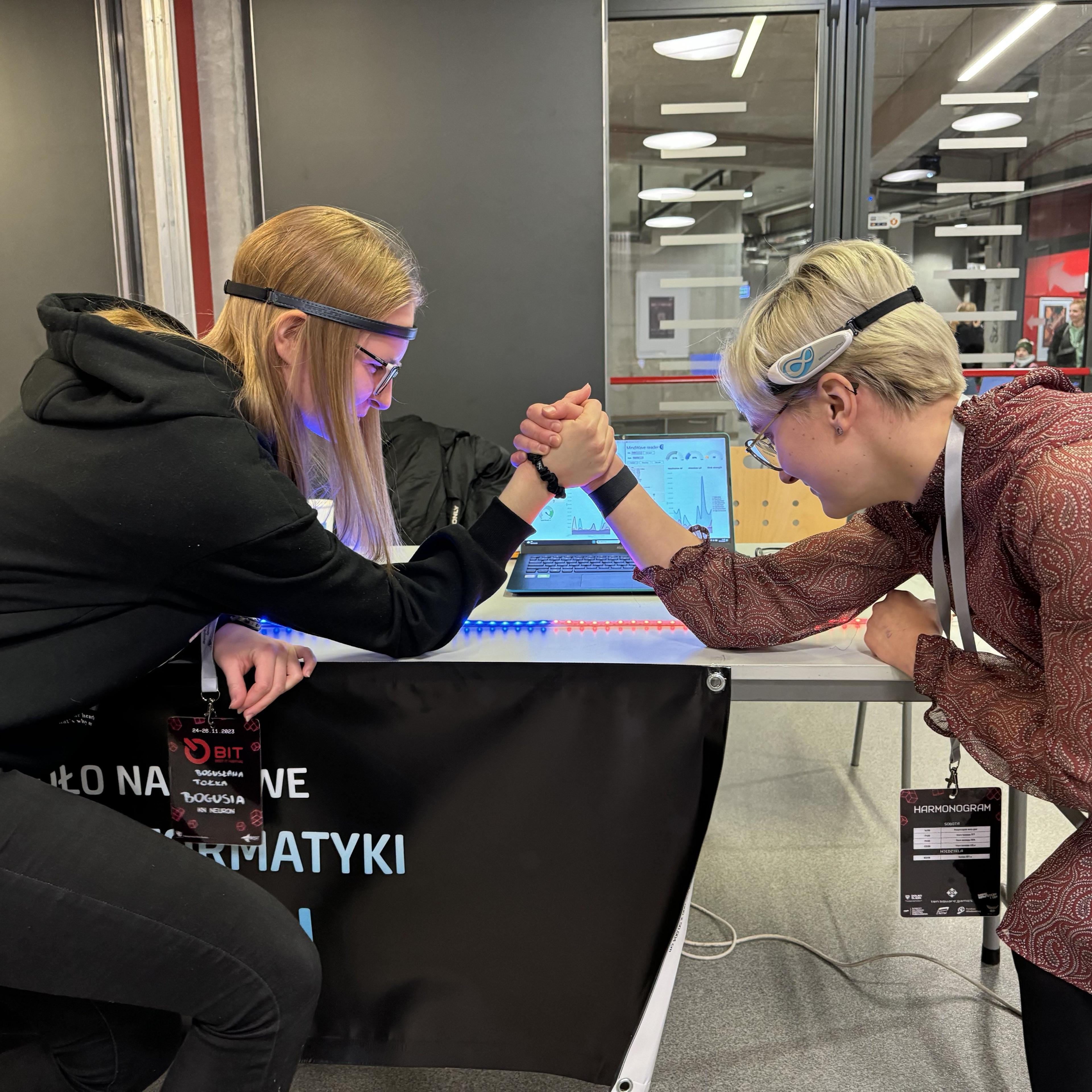
Mind Battle
Mind Battle is a two-player game in which players fight for control of an LED strip in an attempt to increase their focus – whoever is more focused wins. The game was made with the use of an Arduino microcontroller. The project was presented at DAS, DAWiT and BEST IT Festival and enjoyed great popularity.
Learn more→
Neurohorror
Neurohorror is a survival horror game project developed using the Godot engine. The main objective of the project is to integrate classic exploration and puzzle mechanics with a control system based on EEG (electroencephalography) data. The game uses signals from an EEG headset to modify gameplay parameters in real time, introducing an additional layer of interaction between the player's psychophysiological state and the game environment. The goal of the project is to develop a prototype featuring multiple locations with diverse mechanics related to EEG signal analysis.
Learn more→
Attensphere
-
Learn more→
Brain Palette
BrainPalette is a research project currently in its initial phase of development. The team is currently focusing on developing the experimental methodology and defining research parameters, such as the selection of colors, saturation levels, and visual context. The BrainAccess MAXI device is used to record brain signals, enabling the non-invasive measurement of the brain's electrical activity during exposure to visual stimuli. The project is based on the assumption that the brain's reaction to color is not merely a subjective aesthetic feeling, but a measurable neurophysiological phenomenon. The analysis of the collected data aims to allow for the identification of correlations between visual parameters and the user's cognitive-emotional state.
Learn more→
SPEECH-BCI
The SPEECH-BCI project aims to develop an "inner speech" classifier and decoder that will use the EEG signals collected by the BCI. The research will focus on the analysis of signals generated during the process of thinking without verbal expression.
Learn more→
Meditation Training
The Meditation Training app was created especially for people who are just starting their adventure with meditation. Meditation is not an easy activity and a lot of people give up after the first workout. By using the application, we are able to analyze the meditation status graph after the workout and assess whether the training was effective for us.
Learn more→
NeuroScholAR
NeuroScholAR is an innovative educational system that utilizes augmented reality (AR) and brain–computer interfaces (BCI), developed in the Unity engine using the XREAL SDK. The project aims to investigate the impact of modern technologies on the efficiency of cognitive processes and to examine how the digital implementation of ancient mnemonics can accelerate knowledge acquisition. A key element of the system is translating the concept of the memory palace into the user's physical space. Thanks to the XREAL Air 2 Ultra AR glasses, the system allows for the placement of interactive notes and educational objects in specific locations within a room, which engages spatial memory and facilitates subsequent information retrieval. An integral part of the solution is the use of an EEG headset from BrainBit, which monitors the user's mental state in real time.
Learn more→
Neuroflashcard
This project gave rise to the Neuron group and is based on the possibility of using a brain-computer interface (BCI) in the language learning process. The created application allows the user to manage sets of flashcards and use the learning mode using BCI. During the study mode, the user reviews flashcards with an EEG device on their head, and based on the brain activity read, the AI model makes a prediction whether the user knew the flashcard. As part of the project, training data was collected and an artificial intelligence model was trained based on it. The results of the project are promising, as they confirm the possibility of using BCI in the process of learning and consolidating knowledge.
Learn more→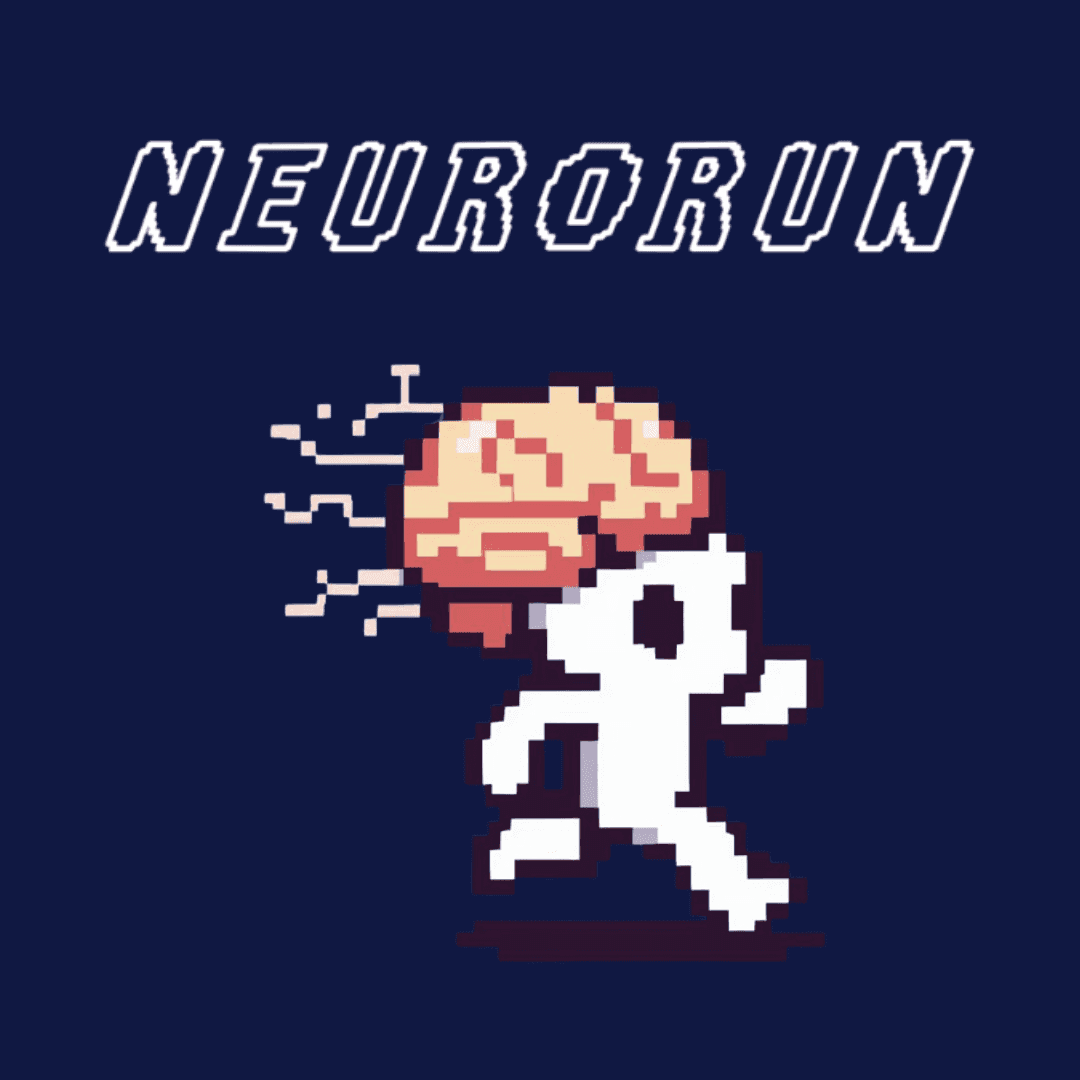
NEURORUN
NEURORUN is a platform game created in Unity, which uses a focus parameter calculated by the internal algorithms of the EEG band to control the game elements. The player must progress through the entire map, overcoming various obstacles along the way, taking turns trying to increase and decrease their focus level.
Learn more→